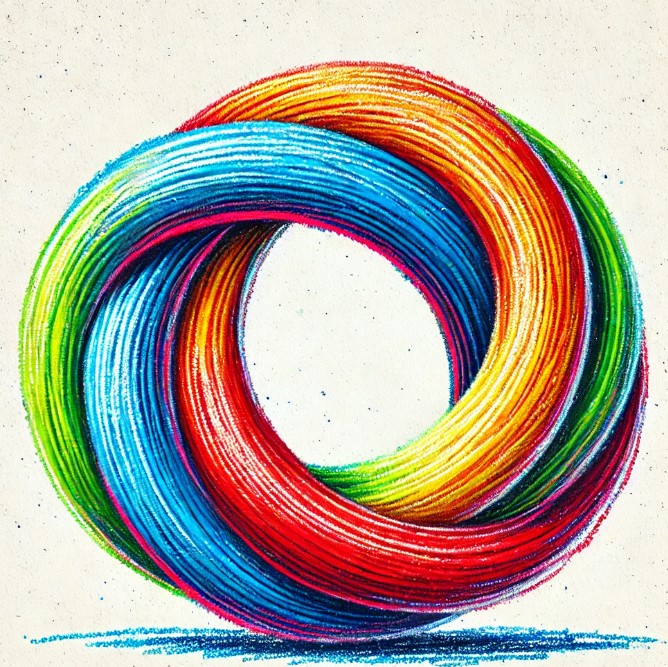
The Great Reshuffling began with the drafting of a brand-new organigramme (trademark pending). Then a second. And a third. In total, six dazzling variations appeared, each more confusing and inspirationally vague than the last. They flowed like modernist poetry—structure without meaning, form without function.
Each version promised to usher in seamless coordination, synergised dynamism, and integrated flexagility (a word invented mid-presentation and immediately embraced). Johnny, glowing with conviction, repeated these terms until they lost all semantic weight and became holy chants.
By the time the six drafts blurred into one unholy hybrid, the system had reached what Ald called “organigrammatical entropy”—a state in which further permutations were neither possible nor intelligible.
“It’s like a cubist painting of bureaucracy,” Ald muttered, adjusting his cracked bifocals as he studied v6.0b_final_FINAL_use_this_one_v3.pdf.
Over the course of several months:
- Teams were redrawn (some upside-down),
- Departments renamed with bright, motivational labels like “Innovation Echo Hub” and “Stakeholder Orchestration Node,”
- Familiar roles dissolved and re-emerged as aspirational abstracts, floating somewhere between dream and spreadsheet.
Employees were ushered into Vision Onboarding Circles, where facilitators with name tags reading “Alignment Enablers” led ice-breakers and purpose-mapping meditations. Everyone received a Strategic Reassignment Letter that opened with a quote from a famous philosopher (often misattributed) and continued with elegant nonsense such as:
“Your role is now dedicated to cultivating cross-functional innovation with a solutions-oriented mindset and participatory ownership.”
One staffer tried to protest: “But… I just run the mailroom.”
He was swiftly reclassified as a Tactical Communications Facilitator.
And let us not forget the Promise to Be Able to Challenge Changes™ — loudly declared at the Vision Summit, where feedback was officially “welcome, encouraged, and appreciated”
As long as it didn’t question the changes, Ald noted silently, already predicting the refrain.
“Consultation is not about changing things,” Manager the 4th clarified. “It’s about feeling heard.”
Eventually, the final structure was unveiled with great fanfare — a PowerPoint deck with no fewer than 72 slides, a live interpretive dance symbolising “Strategic Flow,” and a closing quote from Einstein (almost certainly fake), followed by a final two slides slide that read:
“Together, we’ve aligned our vision,
reimagined our potential,
and futureproofed our legacy.
Please return to your desks and embody your aspirational competencies immediately.”
and
‘GO TEAM!‘
Ald scribbled in the margins of his printout:
“The definition of strategic insanity is using the same slides and expecting different results.” – Ald (but Einstein gets the blame).
Everyone was invited to own their transformation journey.
In the end, and in a nutshell, this is what happened:
- People kept doing what they had always done.
- Job titles lengthened.
- Nobody knew who had authority to approve lunch orders, let alone budgets.
Ald, perched in his stairwell office, had printed out the diagram and pinned it on the wall.
Next to it, he scribbled a sketch of a cartoon snake devouring its own tail in four strategic colours, and labeled it: “Restructuring Ouroboros™ – now with added synergy.” He documented it all in his leather-bound Chronicle of Operational Mysteries, muttering:
“It’s like watching a pot of alphabet soup reclassify itself into lasagna. Decorative layers, no nutritional clarity.”
Still, Johnny stood proudly atop the metaphorical stage, arms wide as if expecting applause. The Great Reshuffling 4.0 was declared a triumphant success. A historic pivot. A monumental leap into future-readiness.
The citizens nodded.
Of course, they did.
They always did.
They knew the drill.
GO TEAM.

 Hedwig's Chronicles
Leave a comment