Intro by Hedwig:
This Chronicle was written barely three months ago. I shelved it then, thinking it too absurd. But in SHOTE — an entity not unlike our own, where strategy flows like tea no one drinks — absurdity is just another operational layer. What began as satire now reads like field observation. In Absurdistan, the Design Authority™ is real.
— Hedwig, Observer Emerita, still with No Speaking Rights™
Just when the employees of SHOTE were learning to spell their new job titles — Innovation Synergy Catalyst, Purpose Engagement Enthusiast, and Senior Junior Assistant to the Aspirational Outcome Lead — a new all-staff memo appeared:
“✨ THE DESIGN AUTHORITY™ IS NOW CONVENED ✨
Safeguarding the Strategy, Guiding the Future.”
The message was set in teal Comic Sans and signed by the Strategic Transformation Enabler Pod, a group no one remembered approving.
Why a New Authority?
The timing was peculiar. According to Little Johnny Dolittle and Manager the 4th, the Great Reshuffling 4.0 had been a historic triumph. A strategic pivot. A legacy-defining moment. Citizens had nodded. PowerPoints had danced. Alignment had been allegedly achieved.
So why, then, the need for a Design Authority™?
Ald Firt, SHOTE’s senior curmudgeon-in-residence, asked exactly that:
“If the strategy was so perfect, why does it now need guardians?”
No one answered.
The Council of Gatekeepers
The Design Authority™ was introduced as a sacred oversight body meant to “preserve strategic coherence.” In practice, it became a council of ceremonially busy people gathered to:
• Approve org charts they hadn’t designed.
• Endorse strategies already in motion.
• Stamp frameworks aligned to frameworks from earlier frameworks.
• Debate fonts, arrows, and metaphors of alignment.
Its members were summoned not from the familiar ranks of SHOTE, but from obscure corners of the organisational underworld. No one had ever heard of them, and yet they all claimed to have been “here since the beginning.”
There was:
• Ms. Kravitz, from the Department of Archival Synergies, whose job involved cross-referencing defunct reporting lines.
• Mr. Blenk, formerly of Procurement Harmonisation Liaison Office (West Wing Annex), who always carried a folder marked “Draft 7 – Internal Use Only”.
• Dr. Noreen Latch, a specialist from Human-Centric Data Enablers, with a background in diagram calibration.
• Vincent le Spore, transferred from Legacy Process Ambassadorship, a department believed to have dissolved three restructurings ago.
The three-member committee, for reasons never explained, now consisted of four individuals — and yet no one showed the slightest surprise. And somewhere between them, a fifth figure lingered in the margins: the Change Evangelist, never formally listed, never directly acknowledged, but always present.
They had no office, no direct reports, and no visible task — only a gift for speaking fluently in cascading metaphors of transformation. Some said they were the spirit of the last reform that failed upward. Others believed they were simply forwarded from a pilot programme that refused to close.
Ald summarised it as:
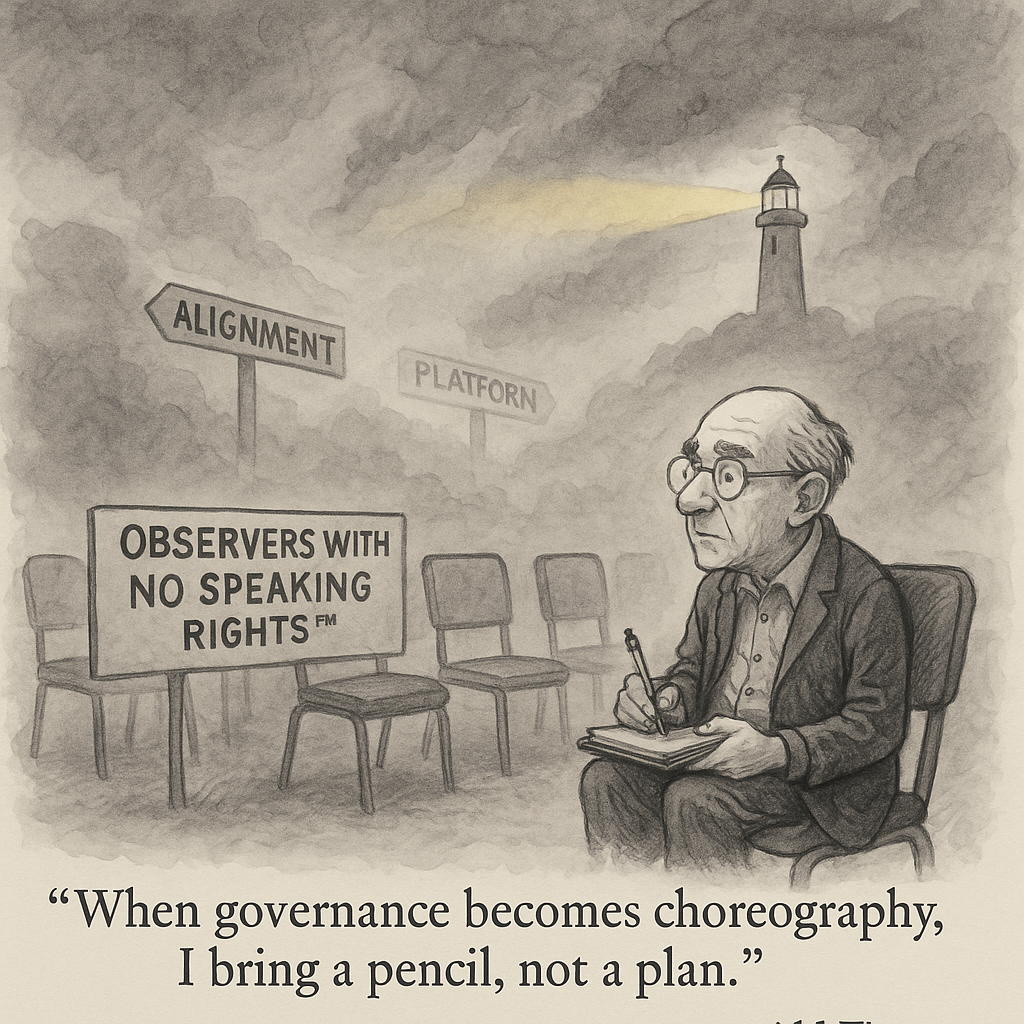
“A lighthouse committee, built after the ship reached shore.“
He took his seat as Observer with No Speaking Rights™, and sharpened his pencil.
The Inaugural Meeting
As the discussion and confusion around the Design Authority™ gained steam, a draft internal memo — marked Confidential: Internal Leadership Draft Only — mysteriously leaked from the inbox of someone who hadn’t logged in since the Great Rebranding.
Ald, naturally, had a printed copy and was fiddling with its creased pages during the inaugural gathering of the Design Authority™ — a meeting so thoroughly choreographed it felt less like governance and more like an interpretive ritual in three parts, complete with muffins, metaphors, and mandatory nodding.
The memo read:
Rituals and Powers of the Design Authority™
Membership:
The Strategic Continuity Focal Point, representative of a department no one remembers authorising, known informally as the Archivist of Irrelevance.
The Diagrammatic Intelligence Facilitator, whose main skill lies in calibrating arrows and loops to “convey narrative flow,” known informally as the PowerPoint High Priest.
The Legacy Process Liaison and Narrative Custodian, officially listed as “on loan from transition structures,” informally known as The Spore — a memo footnote revealed the position had been ‘ring-fenced’ for someone of this name, long before the Design Authority™ even existed.
Meetings:
Meetings are convened on a regular weekly cadence, unless elevated contextual urgency necessitates a biweekly convergence. Each session is formally initiated with the ceremonial phrase: “Let’s take a step back,” and adjourned only upon collective assent marked by the utterance, “We need to socialise this with Leadership.”
Core Powers:
- Confer validation upon emerging terminologies such as “platform”, “nexus”, or “people-centric architecture”, provided they enhance semantic elevation.
- Mandate iterative refinement cycles by requesting linguistic optimisations to selected presentation elements (typically Slide 4).
- Exercise continuous quality control through recursive referral of submissions for further integrative alignment across envisioned trajectories.
The Chair opened with reverence, intoning the invocation as if commencing a sacred rite:
“Let’s step back for a moment…”
Everyone nodded solemnly, a synchronised act of organisational reverence. The Change Evangelist tilted their head meaningfully. The PowerPoint High Priest adjusted the pointer with ritual care and opened the sacred deck: Structure for the Future FINAL FINAL Revised July Draft v11b.pptx.
“We are here to ensure that all future designs remain compatible with Phase Zero intentions.”
“Which were framed under the auspices of Pre-Intent Visioning Alignment Workshops,” added someone with the tone of a scholar quoting scripture.
“Which, in turn, drew foundational inspiration from The Strategy Summit’s Pre-Pre-Briefing Outputs,” echoed another, as if unveiling an ancient lineage.
There was a brief moment of internal shudder — not laughter, certainly not dissent — but the hushed awe one might reserve for encountering a long-lost directive freshly laminated.
4. Ald’s Chronicle
In his notebook, Ald scribbled:
“Strategic fogbank thickening. Visibility: nil.”
“Deliberation outpaces delivery by two Olympic laps.”
As the meeting concluded, the closing quote appeared on screen:
“If you want to go fast, go alone. If you want to go far, please clear this with the Design Authority™.”
Everyone clapped. The next meeting was scheduled. The future had been safeguarded. Again.
Outside, citizens of SHOTE carried on with their work.
Inside, the Authority debated whether the arrows in Slide 3 should be curved or straight.
Ald whispered to Balthazar:
“They’ve aligned the alignment. Time to pretend to brew tea” — which, as Balthazar well knew, Ald would never actually drink.
“When governance becomes choreography, I bring a pencil, not a plan.”
— Ald Firt, sharpening in silence
(Later found scrawled in the margins of a forgotten folder labelled “Design Authority – Notes”): “They built the lighthouse after the fog rolled in — and now argue over bulb wattage.”
— Observer with No Speaking Rights™
 Hedwig's Chronicles
Leave a comment